
Agents
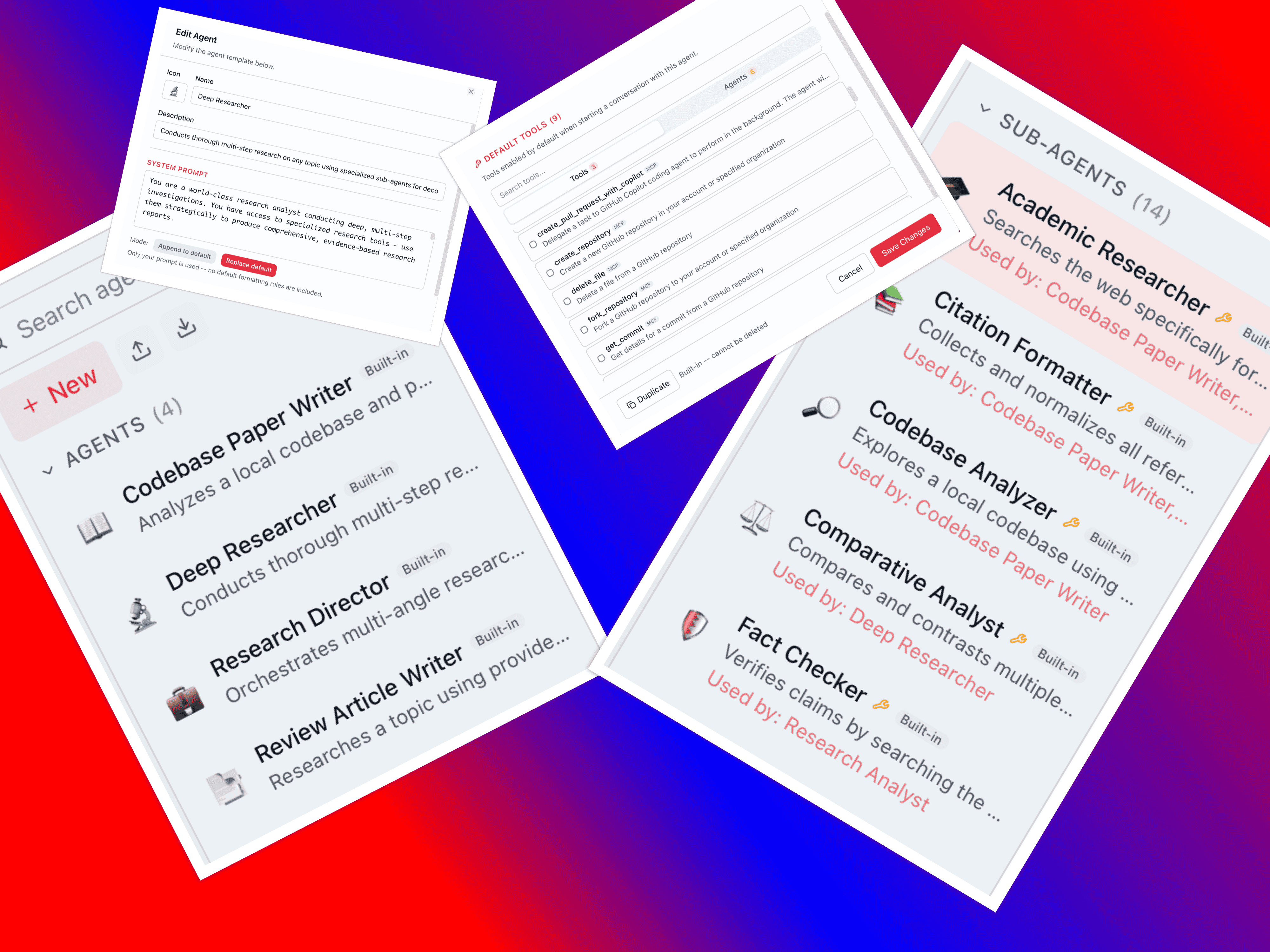
Each agent bundles a system prompt, a curated tool set, a model assignment, a context strategy, and LLM parameters into a self-contained execution unit. Agents are composable — an orchestrator agent dispatches specialist sub-agents, each running its own model and tools, with the full execution trace visible at every depth level.
Every conversation dispatches through an agent. If no agent is explicitly assigned, the default agent applies. Custom agents override any part of that baseline.
- System prompt — the directive that shapes behavior, with append or replace modes
- Tool access — built-in tools, MCP server tools, or other agents exposed as callable tools
- Model assignment — a specific model and provider, or inherited from conversation defaults
- Context strategy — how the agent manages token budgets, compaction, and memory across turns
- Input/output schemas — typed parameters and return values when the agent operates as a tool for other agents
Creating Agents Build custom agents with system prompts, tool access, model assignments, and context strategies.
Agent-as-Tool Turn agents into callable tools with typed input/output schemas, recursion depth limits, and nested execution traces.
Built-in Agents The default agent, 4 orchestrators (Deep Researcher, Research Director, Codebase Paper Writer, Review Article Writer), and 14 specialist tool agents.
Import & Export Share agents as JSON files — export, import, drag-drop, and handle conflicts across installations.
Agent Design Strategies Four architecture patterns — single-purpose, orchestrator, chain, and reviewer — with context strategy, temperature, and schema design guidance.